Are Jury trials a form of co-production?

A while back I was doing some co-production training for Crest Advisory a criminal justice think tank. At the time it got me thinking about juries and co-production. Juries are one of the oldest examples of citizen participation they started around the 12th Century. Today’s modern court room juries would probably be unrecognisable to the 12 knights which Henry 2nd used to help solve land disputes. It’s sad to reflect that now the right be tried by one’s peers might be rationed or curtailed.

In the co-production world, we often like to point out when institutions don’t involve citizens fully in decision making about public services. In a jury trial 12 members of the public advised by a judge make what is surely one of the most critical decisions that can ever be made – whether someone is guilty or innocent of a serious crime. But we don’t usually see this as co-production or citizen participation. Maybe that’s because we take this ancient right for granted. Yet juries share quite a lot of characteristics with good practice in co-production. For example, members of a jury are paid for loss of earnings and can claim travel and refreshment costs. Jurists are involved from the start to the finish of a trial. Juries are advised and supported by the judge and other court officials. Juries even have their own ground rules in the form of the oath they take at the beginning of the trial.

Of course, the jury system is not perfect. But next time someone argues that a decision is too complex to be co-produced or members of the public aren’t qualified to get involved in a particular project. It might be worth reminding them that everyone except perhaps David Lammy seems to accept that the public should be meaningfully involved in that most serious of decision making processes, a criminal trial.

Photo by Nellie Adamyan on Unsplash

Remembering Judy Scott – paying people on benefits expert

This Sunday I attended a wonderful and moving memorial event for Judy Scott the user payments expert and campaigner. It was organised by her son Chris and held in Meanwhile Gardens a community run park in west London. I didn’t know that Judy was one of the small group of people that set up Meanwhile Gardens and established a work project there for people with mental health issues.

Swiss finishing school and mushroom foraging

As often happens at such events you find out that you only really knew about one part of someone’s life.  With Judy I soon realised I there was quite a lot I didn’t know.  I found out from other guests and speakers that Judy went to Swiss finishing school and was related to the architect that designed Battersea power station and the iconic red telephone box. I also learnt about her days as a radical feminist, a clothes designer, her breakdowns and periods of penury her passions for sea fishing and mushroom foraging and that her nickname was ‘JudyMan’.   In this tribute I focus on the part of Judy’s life that I do know about her work around paying people on benefits which is a vital aspect of many co-production and participation projects.

Notional earnings

I really got to know Judy when was working for the Social Care Institute of Excellence (SCIE)  and Judy had become the national expert in an arcane but vitally important   area of benefits legislation called user payments.  Basically, organisations like SCIE wanted to pay disabled people and people with mental health issues and cover their expenses to help shape social policy and services. But the benefits system prevented this. Lots of people were terrified of receiving any sort of payment as it could result in their benefits being stopped.  There was a rule called notional earnings that meant that even if you refused any payment, you could still be treated as if you had been paid.  In the past the payment of any expenses associated with attending a meeting could also be treated as earnings. We basically have Judy to thank for getting the Department of Work and Pensions to change those two rules.

Judy knew more

Judy knew more than anyone else about user payments and the benefits system. She knew more than the civil servants that created the system and wrote the legislation, she knew more than anyone who worked in job centres who were responsible for managing the system, she knew more than benefits experts at the citizen advice bureau who were supposed to be able to advise people about their rights.  She knew more than the people who worked in the finance departments of local councils, NHS trusts and universities. She also knew more than the accountancy firms and lawyers that advised local councils, NHS trusts and universities.

Adventures in the House of Lords

My work with Judy was partly about making sure that people had simple accessible advice about the regulations.  There were lots of loop holes and work arounds that Judy discovered and we made sure that this information was widely available. The other part of the work was more exciting – we campaigned to change the legislation. When I say we really it was Judy who put together a consortium of likeminded organisations who all chipped in to pay her to work as a consultant. Then Judy did the hard work of making connections and finding sympathetic politicians.  Judy’s efforts led to many adventures. She had particular success in the House of Lords through her contact a disabled  Lib Dem peer called Baroness Thomas of Winchester or Celia as she insisted, we call her.  Our visits to the House of Lords became quite regular.  Baroness Thomas was very helpful and got us in front of more and senior officials and politicians.

People reacted quite differently to Judy and her knowledge – some people were overjoyed that someone actually understood the system and could tell them what to do. But other people whose job it was to know about this stuff tended to get a little defensive. Especially when Judy knew the regulations and the legislation better than the people that wrote them and the people that had to job of enforcing them.  I used to take a quiet pleasure in meetings watching people’s discomfort as Judy corrected them on some very detailed but nevertheless vital aspect of the welfare system. It was rather enjoyable to see a senior Department of Work and Pensions official’s blithe confidence fade away as it dawned on them that Judy knew more than them and that Baroness Thomas and I were better briefed than they were.

The Fleischman clause

I have many fond memories of working with Judy.  Once she sent a me a copy of Hansard. It showed that the government had accepted what Judy called the Fleischmann clause. This was something I had suggested in a meeting which unbeknown to me actually got into the regulations. It meant that if someone on benefits didn’t want to accept a payment, they could donate it to a charity of their choice.

Jeffery Archer

Another time Celia invited us to lunch at the House of Lords dining room. We were celebrating some small victories in increasing the rights of people on benefits and protecting them from accusations of fraud for pretty small amounts of money. Ironically who was dining at the table opposite but Jeffery Archer, onetime tory party chairman and notorious convicted fraudster.

Judy’s Legacy

I was very lucky to have worked with Judy. The work we did together at the House of Lords was a career highlight. She was not someone who suffered fools gladly, so I felt privileged that for reasons only known to Judy I was admitted into the small circle of people she trusted. I miss Judy personally and professionally.  There really is no one else like her. She took a very complex issue that most people thought was impossible to solve. Against the odds Judy made a real difference and had a huge positive impact on many people’s lives.


Beyond the usual suspects: Co-production and Casablanca

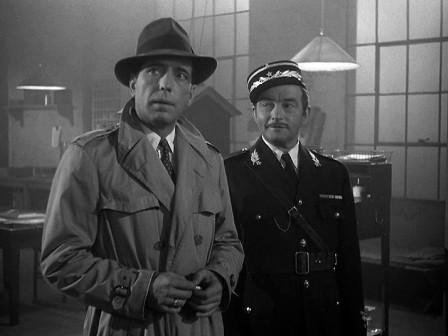
“Round up the usual suspects”. So said Captain Renault, the policemen, played by Claude Rains in the closing moments of Casablanca.

Often professionals I meet through my co-production training and consultancy work seem to disagree with Captain Renault.  They want to move beyond the usual suspects.  On the surface this sounds very sensible. They want to involve a broad range of people  who are representative of the community. And they want to avoid the small group of people who seem to turn up to everything.

You are too articulate and you know too much

But maybe something else is going on. Experts by experience are often held to a higher standard of representativeness than professionals. If a GP joins a working group, they are not asked how representative they are of all local GPs. Usually people are pleased that a GP has taken the time to contribute their perspective and expertise.

But people who use services and carers may face questions about their representativeness. And in some cases this could be seen as a way of undermining their contributions. They might be questioned about how typical they are of local people and about their ability to consult widely. The sub text to these challenges are might be, ‘You’re not like the people who use my service, you’re too articulate and you know how the system works. The implication being that user-led groups should not be represented by good speakers or by people who understand the system.

Instead of being acknowledged as a spokesperson for local people  they become one of the usual suspects. Is this constant need to move beyond the usual suspects a genuine wish to include a diverse range of people or is it so that the clearly articulated but uncomfortable views of local citizen leaders can then be undermined and dismissed as un-representative?

Round up the usual suspects

In my view the ideal mix of people to involve in co-production work is a balance between local user and carer leaders plus a wider group of people who are not ‘usual suspects’.

And it’s vital to be proactive about reaching out to seldom heard or marginalised groups and invite them to get involved. Often the usual suspects are very knowledgeable about their community and they may have a good track record of involving seldom heard groups. So planning some co-production? Then take Captain Renault’s advice and get started by rounding up the usual suspects and start building a beautiful friendship.

Why do I sometimes use a hula hoop in my co-production training?

Co-production; the in and the out group

Co-production is essentially group work. Two groups of people, staff who work in a service and citizens that use the service work together in an equal partnership.  We could somewhat crudely characterise co-production by thinking about it as the coming together of an ‘out group’ and an ‘in group’. Basically, the staff – the ‘in group’ invite some clients from the ‘out group’ to work with them on an activity. There’s lots we can tell people about how to make this process inclusive, and welcoming. We can recommend using ground rules, paying attention to people’s access requirements, covering expenses, carefully considering power imbalances and having clear aims and objectives for the work. This is all great advice, and at Co-production Works we include all this and more in our training. But for people who have not worked co-productively all this information does not help them understand how co-production will actually feel.

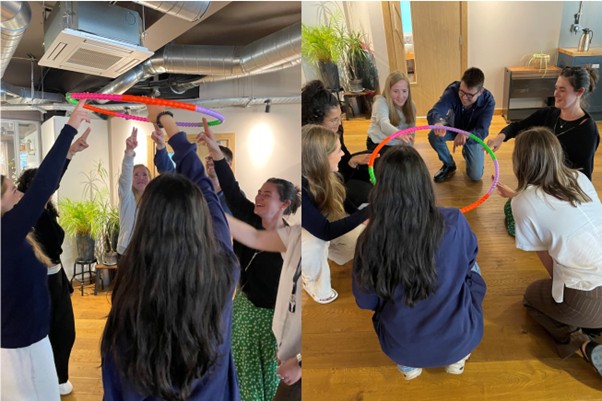
That’s where the hula hoop comes in!

The simple exercise of first lowering the hula hoop first in an ‘in group’ of four and then inviting an ‘out group’ of four more people to complete the same task replicates one of the central experiences of working co-productively.   Just like co-production the exercise is unpredictable – it depends on lots of factors about the group – whether they have worked together before, how well they know each other, what the underlying dynamics are and so on. What usually happens is that the ‘in group’ find the task of lowering the hula hoop relatively easy. When the ‘out group’ join strange things happen. The hula hoop goes up instead of down. Sometimes it can seem like the hoop is possessed by a poltergeist. The hoop wobbles all over the place and the group has to move to follow it. Eventually the hoop gets lowered to the ground.

The reality of co-production

The exercise is enjoyable and a pleasant antidote to the after lunch dip in energy that sometimes happens in training groups. But the interesting thing about it is that it often provokes deep and interesting discussions about co-production.  We can tend to think that co-production is all flowers and rainbows, but the reality is, it is hard, complex and emotional work. The hula hoop exercise enables participants to explore in a safe environment, an experience of what the messy reality of co-production might be like.  It is also enlivening and fun, a nice contrast from the dreaded death by PowerPoint approach to training.

If your team or organisation is interested in co-production training complete the enquiry form or email pete@coproductionworks.co.uk

What is group sentience and how can it help us understand why co-production is anxiety provoking?

Photo by Max Böhme on Unsplash

 In most organisations there is resistance to and anxiety about co-production. This is the case even if on the surface the organisation is positive and enthusiastic about co-production. There are many possible ways of understanding co-production. Accounts of co-production often talk about issues such as power imbalances, inequality and how to level the playing field. These discussions are key to comprehending what is going on in co-production. However, this blog seeks to understand resistance to and anxiety about co-production using the concept of group sentience which was developed by Eric Miller and A. K. Rice in 1967.

Organisations have a sentient boundary. Sentience in this context refers to a ‘system or group that demands and receives loyalty from its members’. A boundary defines what is inside and what is outside an organisation or group. Being part of a sentient group within an organisational boundary provides its members with a sense of identity, a feeling of being part of something and some measure of protection from anxiety. Staff will feel group sentience towards their organisation. In a similar way people with lived experience will experience sentience if they are representatives of a user-led or community organisation and/or if they identify as belonging to particular marginalised groups.

In co-production two groups of people with differing sentience come together to work jointly on a task.  Including in a task, groups of people who are outside of each others sentient boundaries is problematic. For the staff of an organisation, co-production requires bringing in an out-group. This will inevitably disrupt the organisation’s existing defences against anxiety. The citizens engaged in co-production will also experience anxiety as they breach the organisational boundary and enter a realm whose rituals and norms maybe unfamiliar. Citizens may feel unease about whether they will be accepted by the staff group. They may also fear merger with the other and the consequent loss of individual identity. Furthermore, co-production leads to several dilemmas around role. Not only what roles are members of the public going to take up in the organisation but also how is this going to disrupt existing staff roles.

According to Miller and Rice group sentience is likely to be strongest when sentience and task are aligned and when members share a common understanding about the objective of the group. In co-production members of the public are brought in to work with staff specifically because they have a different perspective. Members of the public and staff may not share a common understanding of the task.

Using the lens of sentience the resistance and anxiety provoked by co-production becomes more comprehensible.

For more on this topic see Miller, E. R. and Rice, A. K. (1967) Systems of organization. The control of task and sentient boundaries. London: Tavistock Publications.


How Reflective Practice Groups can support Co-production Specialists

The co-production role, is challenging

The co-production, engagement, participation, or public and patient involvement role in organisations is challenging.  At times it can feel overwhelming and lonely to be leading or managing co-production. Especially if one person or a small team is expected to manage co-production in organisations which have thousands of employees and clients.  There’s no blueprint for how to do co-production, there’s no established right or wrong way to do it. This makes it both exciting and daunting. Often workers are trying to manage the high expectations of both senior leaders and people who draw on support. There may be resistance, misunderstanding and envy from other staff. And this can lead to feeling isolated and under supported.  In addition, we bring so much of ourselves to the work of co-production. Many of us are drawn to this work because we share experiences of distress, disability and/or being let down by the health and welfare systems.

Reflective Practice can help

Reflective Practice Groups are a well established and powerful approach to supporting people doing complex and demanding roles.  A group offers

  • Protected time to step back from the day to day
  • A confidential space to work through challenges and opportunities
  • Build trust with a group of peers
  • Share learning, give and receive support
  • Activate your capacity for finding creative solutions

What did participants say about the Co-production Reflective Practice group?

I have been running a reflective practice group for co-production specialists for two years now. It’s been a wonderful experience to support the group and watch people develop and grow over the year. The group has given members the time and space to explore a range of issues and dilemmas. These have included the power imbalances inherent in the co-production role and how working with this is sometimes uncomfortable. The pressure to be fair and just whilst also setting boundaries, and the complexities of creating safe spaces for everyone participating in co-production.

Group members said they benefited from the regular time to be reflective and to honestly share dilemmas. Over the year they experienced the value of getting under the surface of an issue before leaping to solutions. They learned how helpful it was to pay attention to how issues make one feel and to use this as data to help make sense of things. Members said how much they learnt from each other and how hearing about the struggles of other members reduced feelings of isolation.

“Being part of this reflective practice group has been invaluable to my work in academic patient and public involvement (PPI). In the midst of a busy schedule, it has offered a meaningful space to pause, reflect, and reconnect with the core values that drive my co-production work. The sessions have helped me stay grounded and intentional, and I’ve found the shared insights and support from others in the group both affirming and inspiring.”

Dr Sarah Rees, Public Involvement Lead, National Centre for Mental Health, Cardiff University

The co-production reflective group is open to new members join here


Evaluating co-production and measuring outcomes by Sam Callanan

Two main reasons are put forward for using co-production to improve existing services and design new ones:

  1. Co-production gives people a genuine opportunity to influence the design and delivery of the public services that they use and pay for (indirectly through taxes).
  2. Co-production should deliver better services and decisions because those affected by the services, with real life experience of them, are involved in designing them.

However, to date the evidence that co-production does deliver better services is limited. SCIE’s recent review of the difference that co-production makes in social care (SCIE, 2022) found evidence of benefits for participants in co-production projects, but the available evidence for the impact of co-production on services was weaker.

For people who access services that have taken part in co-production there was evidence of increases in self-confidence, self-esteem and sense of empowerment, better health and wellbeing, increased engagement and trust, and higher levels of satisfaction with and awareness of services (SCIE, 2022, p. 2). For those responsible for designing and delivering services there was evidence of improved job satisfaction, motivation and practice, and increased trust, engagement and dialogue with people who draw on care and support, and with unpaid carers (SCIE, 2022, p. 2).

But the review found that there was less evidence on the difference that co-production makes to services and to the organisations delivering those services. The review notes that in social care in particular more needs to be done to evaluate the outcomes of co-production on services (SCIE, 2022, p. 10). To date there has been limited work on how services have changed following co-production and on linking any changes to the co-production.

To address this future co-production projects need to evaluate both the co-production itself and the impact co-production has on services.

It is important to evaluate whether the service has improved because if we can show that co-production leads to better services that supports the argument for more co-production.

It is also important that the co-production process itself is evaluated because our working hypothesis is that good co-production leads to better services. If the co-production process itself hasn’t worked well, we would be less likely to expect it to lead to improved services.

Evaluating the service being co-produced.

When co-production is used on an existing service we want to find out whether the service has improved since it has been co-produced.

If we are co-producing a new service we want to try and determine whether the service is better (i.e. more fit for purpose) than it would have been if it had not been co-produced.

For existing services, ways of judging service quality may already be in place and these could be used to measure service improvement. Such as:

  • Changes in satisfaction with the service, service user feedback.
  • Feedback from staff delivering the service.
  • Changes in the number or type of complaints.

Exactly what to measure and how to do that will depend on the nature of the project and service.

For some projects there may be objective measures that could be undertaken. For example, in environmental services this might be things such as improvements to pollution levels, reduction in carbon use, or a reduction in landfill.

It is harder to determine whether a new co-produced service is better than it would have been if it had not been co-produced. There may not be an existing service to compare the new service against. However, it is still possible to assess whether the new service meets its goals, and how successful it is through measures such as user satisfaction.

It is worth noting that changes may not be apparent until some time after a new or redesigned service has started, so evidence that services have improved may need to be collected after the co-production part of the project has finished.

Evaluating the co-production

To determine whether a co-production process/project has worked well it may be helpful to consider how well it has followed the principles underlying co-production. Various principles for co-production have been proposed, but most approaches highlight the importance of equality, diversity, contribution, and inclusion.

SCIE set out four core principles:

Equality:

Co-production starts from the idea that no one group or person is more important than any other group or person. In co-production everyone is equal and everyone has assets to bring to the process. Assets refers to skills, abilities, time and other qualities that people have.

Diversity:

Diversity and inclusion are important values in co-production. This can be challenging but it is important that co-production projects are pro-active about diversity and work to reflect and include the range of people who will be using the service.

Accessibility:

Accessibility is about ensuring that everyone has the opportunity to take part in an activity fully in the way that suits them best. Co-production needs to be accessible to allow everyone to contribute on an equal basis.

Reciprocity:

‘Reciprocity’ is a key concept in co-production. It has been defined as ensuring that people receive something back for putting something in. It is a way of showing people that they are valued and needed. It is related to ‘mutuality’ and all parties involved having responsibilities and expectations.

There are many ways in which we can assess whether a co-production project has followed these principles. Methods can be combined to ensure all perspectives are covered.

An evaluator could participate in or observe the project and record what the project did, what worked and what didn’t work. Project documents (terms of reference, meeting notes, etc.) could be reviewed to see what steps were taken to ensure equality, diversity, inclusion and so on. 

This could be complemented by interviews with participants during and after the co-production to capture what worked well, what less well, and why.

Co-production should be flexible and adaptable, with participants able to shape the work. Co-production projects often take a learning approach, with participants actively reflecting on how the project is running and whether it is meeting these principles as the project runs. This both generates evidence to do with how the project is working and allows the project to identify where things are not working and adapt.

As well as trying to build an understanding of whether or not the project actually realised these principles it is important to assess how participants experienced the project. Did they feel that they were treated equally, did they feel heard and valued, were they able to access and contribute to the project in ways that worked for them, did they feel it was a worthwhile use of their time?

Again, this information could be gathered via interviews with participants, surveys, or other feedback mechanisms.

Further evidence of the success (or otherwise) of the co-production and its value to participants can be gathered by evaluating other outcomes that taking part in co-production projects can have for participants. Such as:

  • Whether or not it improved people’s self-confidence or self-esteem.
  • Whether or not people felt more empowered.
  • Whether or not it improved trust or engagement between those using the services and those responsible for designing and delivering them.
  • Whether or not participants came to understand each other better. I.e., did people responsible for delivering services understand more about what people want or need from the service, and how best to deliver it for them? Did people using or drawing on services understand more about the constraints on services, and what is involved in delivering them?

By evaluating both the co-production itself and the difference that co-production makes to services we can build a stronger evidence base around co-production.

It is important that co-production projects are evaluated so that those running them know whether the time and resources invested in the co-production have led to positive outcomes. But it is also important that co-production projects share their findings to grow the evidence base around co-production.

If the evidence demonstrates that co-production has positive benefits for participants and leads to better services then that builds a strong case for more co-production of public services, which would then mean more people experience the benefits of taking part in co-production and then lead to better services for all.

Sam Callanan
Senior Consultant, Strategy unit

If you are interested in finding more about how to evaluate your co-production work please get in touch with co-production works via the enquiry form .

References:

SCIE. (2022). Developing our understanding of the difference co-production makes in social care.